
Maki Kaji puzzle philosophy provides curious players with a fresh, captivating perspective on why sudoku remains one of the most rewarding mental challenges in the modern world. Whether you are taking a well-earned coffee break at your desk, relaxing on your daily commute, or unwinding in the quiet evening hours, a single puzzle session creates an oasis of calm deductive clarity in a busy day. Here on Sudoku Medium, we are committed to sharing the rich background, tactical nuances, and practical wisdom that elevate your everyday puzzle experience.
You can put these concepts to the test immediately on the Sudoku Medium interactive board. To explore a vast world of daily brain teasers, crosswords, jigsaws, and classic card puzzles, visit Easy Daily Puzzle or discover our curated collection of sudoku games on Easy Daily Puzzle.
Maki Kaji puzzle philosophy: the story and strategic heritage of sudoku
The philosophy of modern Sudoku owes its artistic soul to Maki Kaji, who founded the Japanese puzzle publishing house Nikoli in 1980. When Kaji discovered Howard Garns’ American design Number Place in a Tokyo bookstore in 1984, he recognized that pure logic deserved aesthetic elegance. He established two sacred editorial principles: starting clue numbers must exhibit rotational symmetry across the grid, and every single puzzle must be constructed and verified by a human artisan. Kaji adamantly rejected automated computer generators, insisting that a puzzle should feel like a warm, intellectual conversation between constructor and solver. His refusal to aggressively copyright the name Sudoku worldwide allowed the game to become an international gift enjoyed across every continent.
Exploring the deeper aspects of Maki Kaji puzzle philosophy reveals why simple games continue to hold such profound power over the human imagination. Behind every elegant grid, card tableau, or interlocking pattern lies a deliberate balance between order and chaos, designed to challenge our pattern recognition and problem solving faculties. When modern solvers understand these underlying principles, the game transforms from a casual pastime into a deeply satisfying mindful practice. Every round becomes an opportunity to refine your approach, test your hypotheses, and experience the quiet joy of finding the right move.
Historical records and trusted sources behind Maki Kaji puzzle philosophy
Separating documented puzzle heritage from popular hearsay requires consulting authoritative historical and gaming records. For readers eager to examine archival rulebooks, championship history, and technical analyses, reference materials such as Nikoli official Sudoku history and World Puzzle Federation logic competitions offer exceptional factual depth. These trusted publications document the creators, innovators, and international communities who have nurtured these games over centuries. Whether you are researching tournament scoring systems, mathematical proofs, or cultural origins, verified sources ground our modern play in enduring traditions.
How Maki Kaji puzzle philosophy guides player decisions in real games
Imagine opening a demanding grid and spotting a three-by-three box with only three empty squares. The immediate temptation is filling in the first candidate that comes to mind just to make visible progress. Applying Maki Kaji puzzle philosophy reminds you to pause and scan every intersecting row and column for subtle forced constraints. Taking twenty thoughtful seconds to prove a candidate mathematically prevents an erroneous placement that could derail your entire solve ten minutes later.
Expert solvers never treat Sudoku as a guessing game. When you let verified logical eliminations guide your choices, the entire grid begins to unfold with reassuring predictability. Your eyes naturally begin to detect hidden singletons and locked pairs across distant boxes without needing to clutter the squares with distracting pencil marks.
Essential player habits connected to Maki Kaji puzzle philosophy
- Prioritize scanning rows, columns, and boxes with the highest count of given digits.
- Verify every prospective placement against all intersecting constraints before committing.
- Use candidate notes as an active elimination filter rather than passive decoration.
- Take short mental pauses when a box stalls, allowing fresh perspective to reveal simple singles.
Why clean visual design elevates Maki Kaji puzzle philosophy
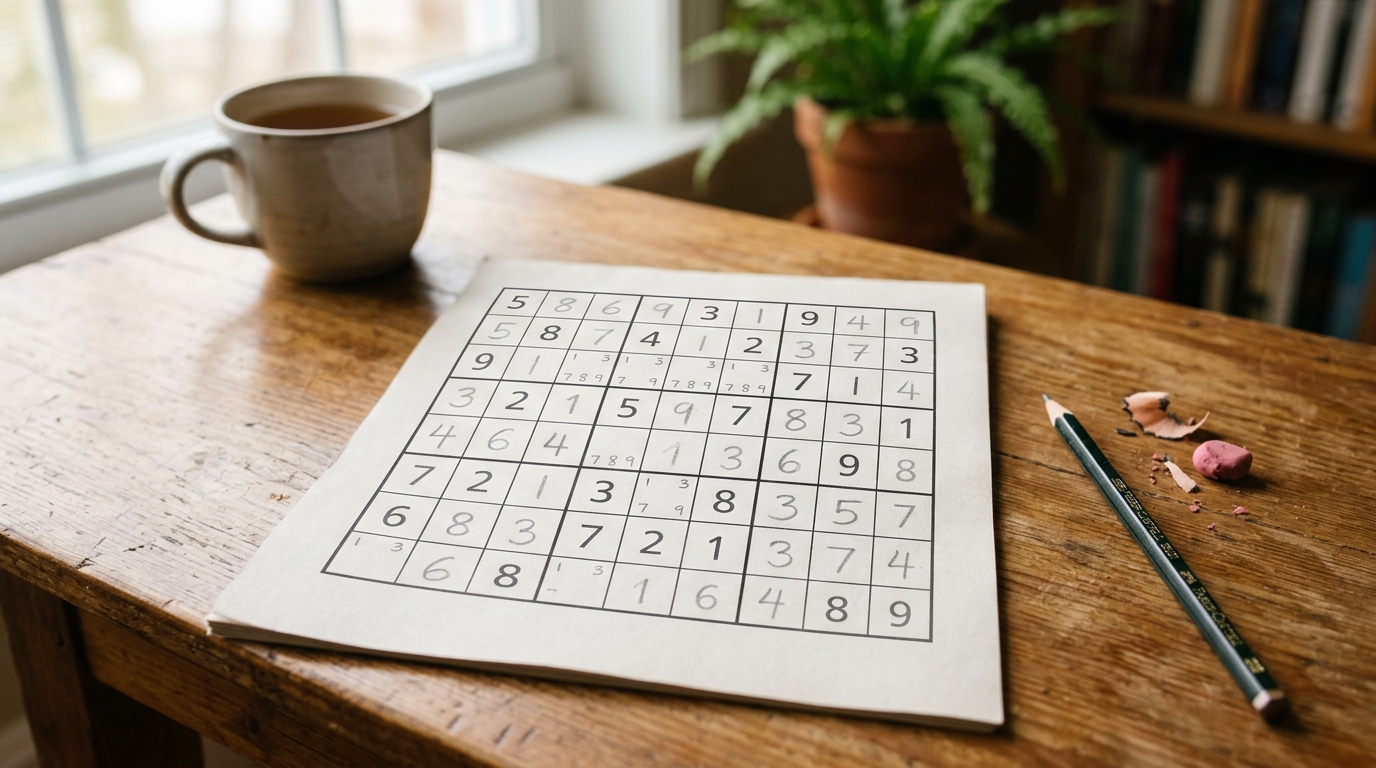
A clean, distraction-free visual presentation is essential for enjoying sudoku on modern devices. The featured illustration accompanying this article has been selected to showcase the focused, calm atmosphere of deliberate play. Pairing clear visual graphics with descriptive alt text highlighting Maki Kaji puzzle philosophy ensures that solvers can comfortably connect theory with on-screen action. Whether you are playing on a high-resolution desktop monitor or a compact mobile screen, sharp contrast and thoughtful interface design keep your focus squarely on the pleasure of solving.
Taking your next step with Maki Kaji puzzle philosophy
The most enjoyable way to appreciate the power of Maki Kaji puzzle philosophy is to dive into an actual round today with these fresh insights in mind. Head over to Sudoku Medium for a relaxing, high-quality session where thoughtful strategy replaces rushed guessing. Whenever you want to expand your puzzle horizons with fresh daily challenges, explore the comprehensive Easy Daily Puzzle library for endless daily mental stimulation. Every completed puzzle is a testament to the timeless joy of clear logic, patient observation, and a well-played game.