
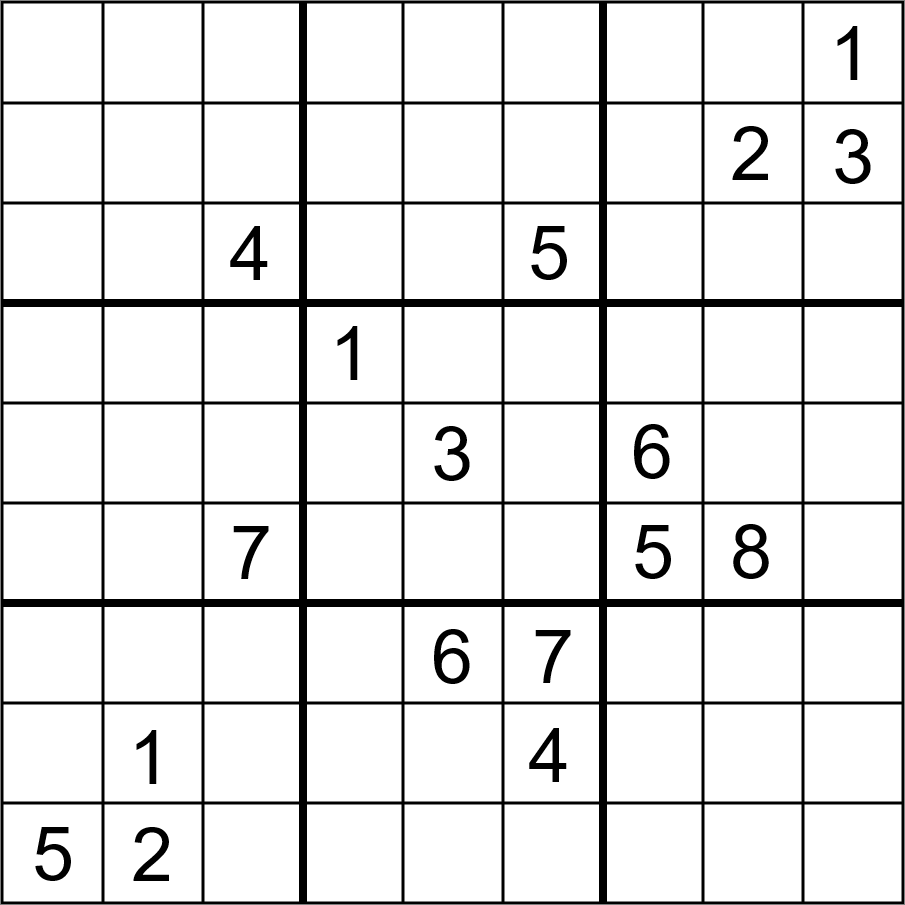
Medium Sudoku becomes easier to enjoy once the rules are treated as information rather than obstacles. Medium boards are a useful middle ground because they expose weak habits without burying a player under advanced notation. The goal is not to memorize every advanced trick. It is to understand what a legal move reveals, what it closes, and when a tempting shortcut creates a harder board. A few plain habits can make the next session feel more readable without taking away the discovery.
Medium Sudoku in practice
The three constraints that define the game
Sudoku has one central rule expressed three ways: a digit from one through nine can appear only once in each row, column, and 3-by-3 box. A legal move must satisfy all three at the same time. That is why a number that fits a row may still be impossible in the box, and why solving is mostly the art of comparing overlapping information.
Start with the units that are closest to complete. A row missing two digits gives you a short candidate list. Then check the columns and boxes that cross those empty cells. This simple loop is the foundation for more advanced techniques because it keeps the board grounded in evidence rather than intuition.
Variants change the question, not the discipline
Diagonal Sudoku adds two marked diagonals that also cannot repeat. Killer Sudoku adds cage totals and often a no-repeat rule inside each cage. Samurai Sudoku joins several grids into one larger structure. The extra rule changes where you look, but the habit remains the same: identify the constraints first, then place only what they allow.
A useful beginner mistake to avoid is treating a variant as a license to guess. The new lines, cages, or overlapping grids are not decoration. They are additional information. Read them early and the puzzle usually becomes more manageable, not more mysterious.
A simple routine for the next board
Scan rows, columns, and boxes once before writing heavily. Record candidates only where they reduce uncertainty. After every confirmed digit, revisit the units that touch it. Play a Sudoku grid on the main site and find related Sudoku rules and tips here. Nikoli’s official explanation is a useful external reference for the classic format and its name.
A clean checklist for the next game
Before the next board, decide what counts as evidence. A single candidate left in a unit is evidence. A number that merely feels comfortable is not. This small distinction keeps the solve honest and makes a later review possible. When a puzzle goes wrong, you can return to the first unsupported choice instead of blaming the entire board.
Give the opening a fixed amount of time. Scan the rows, columns, and boxes once, then begin with the area that has the fewest legal options. If the scan produces nothing, that is useful information too. It tells you to switch from direct placements to candidate notes rather than forcing a move. The board is not asking for speed yet; it is asking for a better question.
After every confirmed digit, revisit only the units it touches. This keeps the work light and prevents the common habit of restarting the whole scan after every move. Small loops are easier to maintain than a dramatic full-board search, especially on a phone where visual fatigue arrives quickly.
When you finish, write down one observation instead of only the time: a box you missed, a note you forgot to erase, or a moment when waiting helped. Then try another daily puzzle on Easy Daily Puzzle or search this site for more sudoku guides. A useful routine grows from those small observations.
The small detail worth remembering
A puzzle session becomes more satisfying when the player can explain one decision afterward. It might be a hidden single, a careful box scan, or simply the moment they chose not to guess. Explanation turns a completed board into practice that carries forward.
That is the durable appeal of a clean grid. The rules stay fixed, but the player’s attention keeps getting more precise. A few quiet sessions are enough to make the next board feel less like a wall and more like a conversation with evidence.
If the board feels difficult, lower the speed before lowering the standard. A slower scan with honest notes usually teaches more than a quick guess followed by a long repair.
For a little more context, read Nikoli’s Sudoku background and TIME on Wayne Gould and Sudoku’s spread. These references are useful for checking the basic history or rules without turning a daily game post into a long reference list.